
Last Updated: June 2026
Forgetting a name. Misplacing your keys. Walking into a room and forgetting why.
Most adults experience moments like these as they get older.
But when memory lapses start happening more often, it’s natural to wonder:
“Is this normal aging, or could it be dementia?”
This is one of the most common questions people ask when they begin noticing changes in memory, focus, or mental clarity.
The good news is that some cognitive changes are a normal part of aging.
The challenge is understanding where normal aging ends and where symptoms may deserve closer attention.
This guide will help you understand the key differences, recognize common warning signs, and know when it may be appropriate to seek further evaluation.
What Is Normal Aging?
Normal aging refers to natural changes that occur in the brain and body over time.
Just as vision, hearing, and physical strength may change with age, certain cognitive functions can also become less efficient.
This does not mean the brain stops working well.
In fact, many older adults maintain strong cognitive abilities well into later life.
Normal aging may include:
- Slower recall of information
- Occasional forgetfulness
- Taking longer to learn new technology
- Increased reliance on reminders
- More difficulty multitasking
These changes are often frustrating, but they generally do not interfere significantly with daily independence.
What Is Dementia?
Dementia is not a normal part of aging.
It is a general term used to describe symptoms that affect:
- Memory
- Thinking
- Reasoning
- Communication
- Judgment
- Daily functioning
Dementia occurs when cognitive decline becomes severe enough to interfere with everyday life.
Alzheimer’s disease is the most common cause of dementia, but there are several different types.
Unlike normal aging, dementia typically involves progressive changes that worsen over time.
The Most Important Difference
The key distinction is not whether memory lapses occur.
It’s whether those changes interfere with daily life.
Normal Aging
You may forget information temporarily but eventually remember it.
You remain independent and capable of managing daily responsibilities.
Dementia
Memory and thinking problems become significant enough to affect:
- Work
- Finances
- Driving
- Household tasks
- Communication
- Personal independence
The overall pattern matters more than isolated incidents.
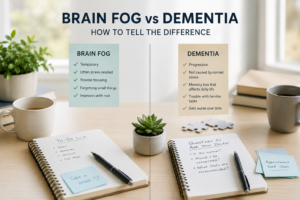
Normal Aging vs Dementia: Side-by-Side Comparison
| Normal Aging | Dementia |
| Occasionally forgetting names | Frequently forgetting recently learned information |
| Misplacing items but finding them later | Placing items in unusual locations and being unable to retrace steps |
| Slower recall | Difficulty retaining new information |
| Forgetting why you entered a room | Forgetting familiar routines or tasks |
| Needing reminders | Increasing dependence on others for daily activities |
| Stable symptoms | Symptoms worsen over time |
| Aware of memory lapses | Awareness may decrease as symptoms progress |
Examples of Normal Aging
Many experiences that feel concerning are actually common age-related changes.
Forgetting Names
You recognize someone immediately but need extra time to remember their name.
The name often comes back later.
Slower Recall
You know the answer but need a few extra seconds to retrieve it.
Misplacing Items Occasionally
You lose your glasses or keys but can usually find them after retracing your steps.
Losing Your Train of Thought
Distractions, stress, and multitasking can affect concentration.
Needing Lists and Reminders
Using calendars, notes, and reminders becomes increasingly helpful as life becomes more complex.
These experiences alone generally do not suggest dementia.
Signs That May Deserve Closer Attention
Certain patterns may warrant further evaluation.
Frequently Forgetting Recent Information
Examples include:
- Forgetting conversations
- Forgetting appointments despite reminders
- Repeatedly asking the same questions
Difficulty Managing Familiar Tasks
Tasks that were once routine become increasingly difficult.
Examples include:
- Paying bills
- Following recipes
- Managing medications
Getting Lost in Familiar Places
Difficulty navigating familiar routes or environments.
Increased Confusion
Confusion about dates, locations, or everyday situations.
Changes in Judgment
Poor financial decisions or unusual behavior changes.
Progressive Worsening
Symptoms become more frequent and more severe over time.
This pattern is often more important than any individual symptom.
What About Mild Cognitive Impairment (MCI)?
There is a middle ground between normal aging and dementia known as Mild Cognitive Impairment (MCI).
People with MCI experience cognitive changes that are greater than expected for age but not severe enough to significantly interfere with independence.
MCI may involve:
- Noticeable memory changes
- Increased forgetfulness
- Difficulty finding words
- Reduced concentration
Some individuals with MCI remain stable for years.
Others may improve or progress.
Common Causes of Memory Changes That Are Not Dementia
Many memory complaints have explanations unrelated to dementia.
Stress
Stress can affect attention and memory retrieval.
Poor Sleep
Sleep deprivation can significantly impact concentration and recall.
Menopause and Hormonal Changes
Many women experience memory complaints and brain fog during hormonal transitions.
Anxiety and Depression
Mental health conditions can influence cognitive performance.
Medical Conditions
Conditions such as thyroid disorders, vitamin deficiencies, and sleep apnea can affect memory.
When Should You Seek Evaluation?
Consider speaking with a healthcare professional if:
- Symptoms are worsening
- Daily activities are becoming more difficult
- Family members express concern
- Memory changes interfere with work or relationships
- Confusion is increasing
Seeking evaluation doesn’t mean dementia is present.
Often, it helps identify treatable or manageable causes.
How to Support Healthy Cognitive Aging
While aging cannot be stopped, certain habits support long-term cognitive health.
Prioritize Sleep
Sleep plays a critical role in memory and brain function.
Stay Physically Active
Exercise supports both cardiovascular and cognitive health.
Stay Socially Connected
Meaningful social interaction stimulates multiple cognitive systems.
Challenge Your Brain
Reading, learning, hobbies, and problem-solving activities help keep the brain engaged.
Manage Chronic Health Conditions
Controlling blood pressure, diabetes, and other health issues supports brain health.
Frequently Asked Questions
Is memory loss a normal part of aging?
Some memory changes are common with age, including slower recall and occasional forgetfulness.
What is the biggest difference between aging and dementia?
The biggest difference is whether cognitive changes interfere with daily independence and worsen over time.
Can stress mimic dementia?
Yes. Stress, poor sleep, anxiety, and hormonal changes can create symptoms that resemble cognitive decline.
Does forgetting names mean dementia?
Not necessarily. Occasional difficulty recalling names is common with aging.
Should I get tested if I’m worried?
If symptoms are persistent, worsening, or affecting daily life, discussing concerns with a healthcare professional may be appropriate.
Final Thoughts
Experiencing memory lapses can feel unsettling, especially when stories about dementia are everywhere.
But many cognitive changes are a normal part of aging and do not indicate dementia.
The goal is not to ignore symptoms—or assume the worst.
It’s to understand the difference, pay attention to patterns, and seek guidance when concerns persist.
Knowledge creates perspective.
And perspective can help replace fear with informed action.