
Last Updated: June 2026
Have you ever found yourself in the middle of a conversation, knowing exactly what you want to say but unable to find the right word?
Perhaps you forget the name of someone you’ve known for years. Or maybe a common word seems to disappear just when you need it most.
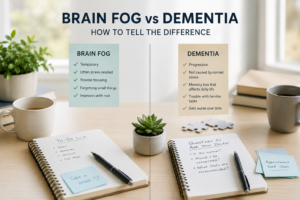
For many adults over 50, these experiences can be unsettling. It’s often one of the first changes people notice, and it can trigger concerns about memory loss, dementia, or cognitive decline.
The good news is that occasional word-finding difficulties are surprisingly common as we age.
In many cases, they are not a sign of dementia.
Understanding why word-finding problems happen—and when they may deserve closer attention—can help replace fear with perspective.
What Is Word-Finding Difficulty?
Word-finding difficulty occurs when you know a word but can’t retrieve it immediately.
You may:
- Pause longer than usual during conversations
- Substitute a similar word
- Describe the object instead of naming it
- Remember the word later
For example:
You see a “stapler” on your desk but momentarily call it “that paper thing.”
Or you recognize a neighbor but can’t immediately recall their name.
These experiences are often frustrating, but they are also common.
Why Does It Happen More Often After 50?
Several normal age-related changes can affect how quickly we retrieve words.
Slower Processing Speed
As we age, the brain may require slightly more time to access stored information.
The information is still there—it simply takes longer to retrieve.
More Information Stored
Ironically, older adults often have larger vocabularies and more life experiences than younger adults.
With more information stored, retrieval can occasionally become slower.
Attention Changes
Memory and attention work together.
If attention is divided, word recall often becomes more difficult.
Increased Cognitive Load
Many adults in their 50s and 60s are balancing:
- Work responsibilities
- Family caregiving
- Financial concerns
- Health management
Mental overload can affect recall.
Common Causes of Word-Finding Problems
Stress
Stress is one of the most common causes of temporary memory and language difficulties.
When your brain is focused on stressors, it may have fewer resources available for memory retrieval.
Common signs include:
- Losing your train of thought
- Forgetting names
- Struggling to recall familiar words
Poor Sleep
Sleep plays an essential role in memory consolidation.
Poor sleep may contribute to:
- Brain fog
- Reduced concentration
- Slower recall
- Mental fatigue
Menopause and Hormonal Changes
Many women experience cognitive changes during perimenopause and menopause.
Common complaints include:
- Word-finding difficulties
- Forgetfulness
- Reduced mental clarity
These symptoms are often temporary and may fluctuate over time.
Anxiety
Anxiety can make normal memory lapses feel more significant than they are.
When you’re worried about forgetting something, your attention becomes focused on every mistake.
Multitasking
Trying to do too many things at once often interferes with memory retrieval.
Many apparent memory problems are actually attention problems.
What Is Usually Considered Normal?
Occasional word-finding difficulties are generally considered normal when:
- They happen infrequently
- The word eventually comes back
- Daily functioning remains intact
- Symptoms are relatively stable
Examples include:
Forgetting a Name
You recognize someone immediately but need a moment to remember their name.
Pausing During Conversation
You know what you want to say but need extra time to find the word.
Remembering Later
The missing word comes to you minutes or hours afterward.
These experiences are often associated with normal aging rather than cognitive decline.
When Might Word-Finding Problems Be Concerning?
Certain patterns deserve closer attention.
Increasing Frequency
The problem occurs more often over time.
Communication Difficulties
Conversations become difficult because words cannot be retrieved.
Incorrect Word Substitutions
Frequently using incorrect or unrelated words.
Impact on Daily Functioning
Symptoms interfere with work, social interactions, or everyday responsibilities.
Progressive Worsening
Family members begin noticing significant changes.
The overall pattern matters more than any single incident.
Conditions That Can Affect Word Retrieval
Several conditions can influence language and memory.
Mild Cognitive Impairment (MCI)
MCI involves cognitive changes greater than expected for age but not severe enough to significantly impact independence.
Depression
Depression can affect concentration, memory, and information processing.
Sleep Disorders
Sleep apnea and chronic sleep deprivation may affect cognitive performance.
Neurological Conditions
Some neurological disorders may involve language changes as part of broader cognitive symptoms.
However, these conditions usually involve additional symptoms beyond occasional word-finding difficulty.
What You Can Do to Improve Recall
Slow Down
Giving yourself extra time often improves retrieval.
Reduce Multitasking
Focus on one task or conversation at a time.
Improve Sleep
Consistent sleep habits support memory function.
Manage Stress
Mindfulness, exercise, and relaxation techniques may improve concentration.
Stay Socially Engaged
Conversation challenges the brain and supports cognitive function.
Keep Learning
Learning new skills may help maintain cognitive flexibility.
When Should You Talk to a Doctor?
Consider speaking with a healthcare professional if:
- Symptoms are worsening
- Daily functioning is affected
- Communication becomes increasingly difficult
- Family members express concern
- Other cognitive symptoms are appearing
Many causes of memory complaints are treatable.
Evaluation can provide reassurance and clarity.
Frequently Asked Questions
Is forgetting words a sign of dementia?
Not necessarily. Occasional word-finding difficulty is common and often associated with normal aging, stress, poor sleep, or hormonal changes.
Does menopause affect word recall?
Yes. Many women report temporary cognitive changes during perimenopause and menopause.
Can stress cause word-finding problems?
Absolutely. Stress affects attention and memory retrieval.
Can memory improve?
In some cases, yes. Addressing sleep, stress, health conditions, and lifestyle factors may improve cognitive performance.
Final Thoughts
Forgetting a word from time to time can feel alarming, especially if you’ve seen a loved one experience cognitive decline.
But occasional word-finding difficulties are common and often have explanations that are unrelated to dementia.
The key is to pay attention to patterns rather than isolated incidents.
Most importantly, remember that noticing a symptom does not automatically mean something serious is wrong.
Understanding what is normal—and knowing when to seek further guidance—can help you move forward with greater confidence and less fear.