
Last Updated: June 2026
In recent years, researchers have made significant progress in developing tests that may help identify biological changes associated with Alzheimer’s disease earlier than ever before.
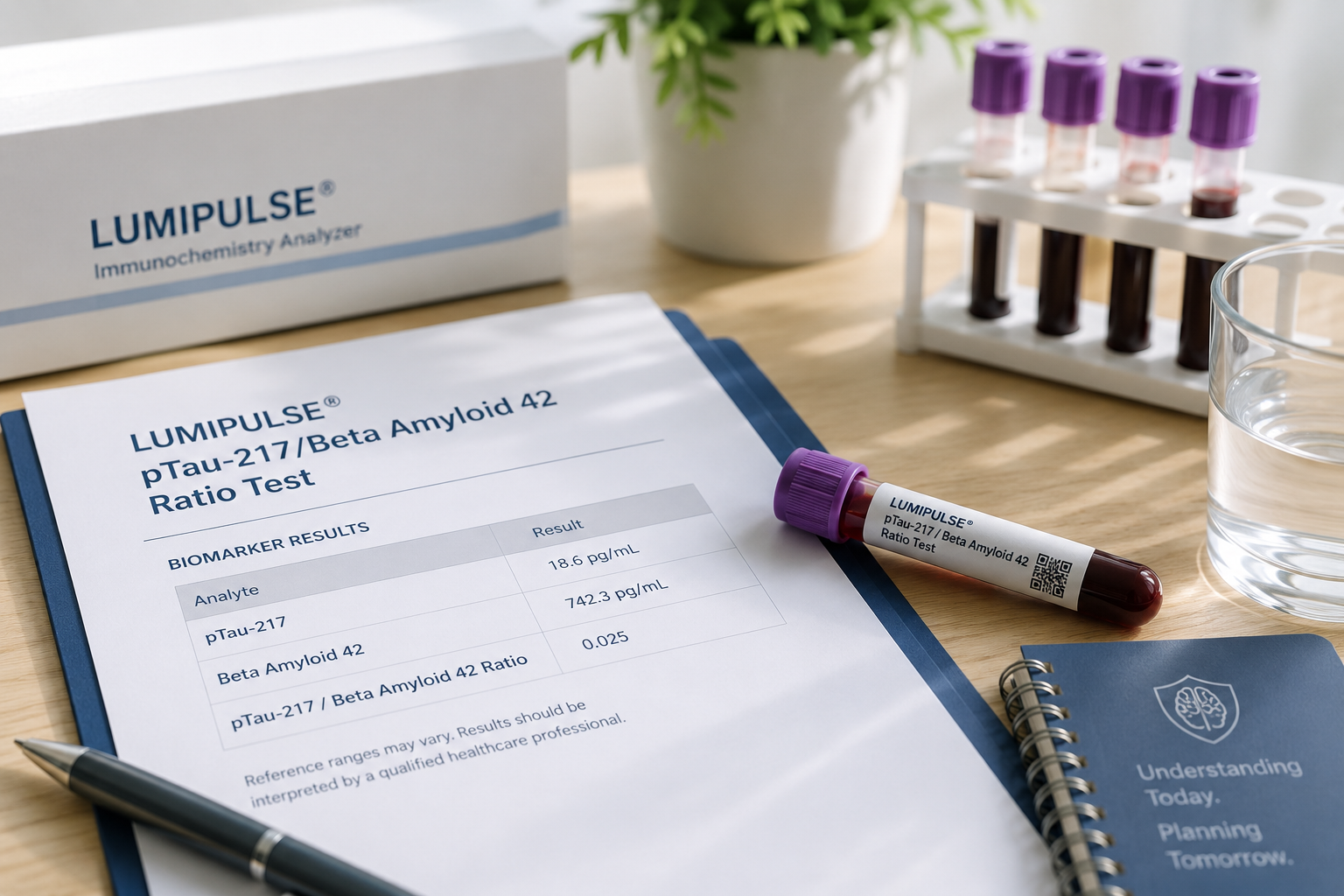
One test receiving increasing attention is the Lumipulse® pTau-217/Beta Amyloid 42 Ratio Test.
For many people, hearing about new Alzheimer’s blood tests can raise important questions:
- What exactly does this test measure?
- Who might benefit from it?
- Does a positive result mean I have Alzheimer’s disease?
- What should I do if my results are abnormal?
Understanding what this test can—and cannot—tell us is important.
This guide explains the Lumipulse pTau-217/Beta Amyloid 42 Ratio Test, how it works, and what it may mean for individuals concerned about memory changes and cognitive health.
What Is the Lumipulse® pTau-217/Beta Amyloid 42 Ratio Test?
The Lumipulse pTau-217/Beta Amyloid 42 Ratio Test is a laboratory test designed to measure specific biomarkers associated with Alzheimer’s disease.
Biomarkers are measurable biological indicators that may provide information about processes occurring inside the body.
In Alzheimer’s research, two biomarkers have received significant attention:
- Phosphorylated tau (pTau-217)
- Beta amyloid 42
Researchers believe changes in these proteins may be associated with the biological processes involved in Alzheimer’s disease.
The Lumipulse test evaluates the relationship between these biomarkers to help healthcare professionals assess whether additional evaluation may be appropriate.
What Are Biomarkers?
A biomarker is any measurable characteristic that provides information about a biological process.
Examples include:
- Blood pressure
- Cholesterol levels
- Blood glucose levels
- Hormone levels
In brain health and neurology, biomarkers may help researchers and healthcare professionals better understand changes occurring within the brain.
It is important to understand that biomarkers are not the same as symptoms.
A person may experience memory concerns without abnormal biomarker findings.
Likewise, biomarker changes can occur before noticeable symptoms appear.
Understanding pTau-217
Tau is a protein naturally found in the brain.
Its normal role is to help support the structure and function of nerve cells.
Researchers have found that certain forms of tau become altered during Alzheimer’s disease.
One of these forms is called:
Phosphorylated Tau 217 (pTau-217)
Elevated pTau-217 levels have been associated with biological changes linked to Alzheimer’s disease in research studies.
Because of this, pTau-217 has become one of the most closely studied Alzheimer’s biomarkers.
Understanding Beta Amyloid 42
Beta amyloid is another protein involved in Alzheimer’s research.
Researchers believe that abnormal accumulation of beta amyloid may contribute to the development of amyloid plaques within the brain.
Amyloid plaques are one of the hallmark features observed in Alzheimer’s disease.
Beta Amyloid 42 is a specific form of amyloid that researchers frequently measure when evaluating Alzheimer’s-related biomarkers.
Why Measure the Ratio?
The Lumipulse test does not simply look at one biomarker in isolation.
Instead, it evaluates the relationship between:
- pTau-217
- Beta Amyloid 42
Researchers have found that examining these biomarkers together may provide additional information compared with measuring either biomarker alone.
The goal is to help identify biological patterns that may warrant further clinical evaluation.
Is This an Alzheimer’s Blood Test?
Many news reports describe tests involving pTau biomarkers as “Alzheimer’s blood tests.”
While that description is understandable, it can sometimes be misleading.
The Lumipulse pTau-217/Beta Amyloid 42 Ratio Test is not intended to independently diagnose Alzheimer’s disease.
A diagnosis typically involves multiple factors, including:
- Medical history
- Cognitive symptoms
- Physical examination
- Cognitive testing
- Imaging studies when appropriate
- Laboratory testing
Biomarker testing represents one piece of a much larger clinical picture.
Who Might Be Offered This Test?
Healthcare professionals may consider biomarker testing for individuals experiencing:
- Memory concerns
- Cognitive symptoms
- Changes in thinking abilities
- Questions regarding possible neurodegenerative conditions
Testing decisions are individualized.
Not everyone experiencing memory changes requires biomarker testing.
Healthcare providers consider factors such as:
- Age
- Symptoms
- Medical history
- Family history
- Existing evaluations
What Does an Abnormal Result Mean?
This is one of the most important questions people ask.
An abnormal biomarker result does not automatically mean a person has Alzheimer’s disease.
Likewise, it does not predict exactly how symptoms may progress in the future.
Biomarker results must be interpreted within the broader context of:
- Symptoms
- Medical history
- Cognitive evaluation
- Additional testing when necessary
Only a qualified healthcare professional can explain what a particular result may mean for an individual situation.
What Does a Normal Result Mean?
Normal results can provide useful information, but they should not be viewed as a guarantee regarding future cognitive health.
Symptoms can have many possible causes, including:
- Stress
- Sleep disorders
- Depression
- Anxiety
- Medication effects
- Hormonal changes
- Medical conditions unrelated to Alzheimer’s disease
A healthcare professional may still recommend further evaluation if concerns continue.
How Does This Compare to Cognitive Testing?
Cognitive testing and biomarker testing serve different purposes.
Cognitive Testing
Measures:
- Memory
- Attention
- Language
- Problem-solving
- Executive function
Biomarker Testing
Measures:
- Biological indicators associated with Alzheimer’s disease
Many evaluations involve both approaches because they provide different types of information.
How Does This Compare to Brain Imaging?
Historically, some Alzheimer’s biomarkers have been evaluated through imaging techniques such as PET scans.
Blood-based biomarker tests may offer potential advantages including:
- Greater accessibility
- Less invasive procedures
- Lower cost in some situations
- Faster testing process
However, healthcare providers determine which testing approach is most appropriate based on individual circumstances.
Questions to Ask Your Healthcare Provider
If you are considering biomarker testing, it may be helpful to ask:
- Why are you recommending this test?
- What information can this test provide?
- What are the limitations?
- How might the results affect next steps?
- Will I need additional testing?
- How should results be interpreted alongside my symptoms?
These questions can help create a more informed discussion.
What Should You Do If You’re Concerned About Memory Changes?
If you have noticed persistent changes in memory, focus, or thinking abilities:
Step 1: Track Symptoms
Keep notes regarding:
- Frequency
- Severity
- Situations where symptoms occur
Step 2: Learn What’s Normal
Many memory changes can occur with normal aging.
Understanding the difference between expected changes and potential warning signs can reduce unnecessary anxiety.
Step 3: Speak With a Healthcare Professional
Persistent concerns deserve discussion with a qualified provider.
Step 4: Consider Recommended Testing
Testing decisions should be guided by your healthcare team rather than internet searches alone.
Key Takeaways
The Lumipulse® pTau-217/Beta Amyloid 42 Ratio Test is a biomarker test designed to measure biological indicators associated with Alzheimer’s disease.
It evaluates two important biomarkers:
- pTau-217
- Beta Amyloid 42
While these biomarkers may provide valuable information, they do not independently diagnose Alzheimer’s disease.
Biomarker testing is most useful when considered alongside symptoms, cognitive testing, medical history, and professional evaluation.
If you’re concerned about memory changes, understanding your options and seeking appropriate guidance can help you move from uncertainty toward greater clarity.
Medical Disclaimer
This article is for educational purposes only and is not intended to diagnose, treat, or provide medical advice. Always consult a qualified healthcare professional regarding symptoms, testing decisions, or concerns about cognitive health.